
Learning Language with Shows: Making Bilingual Subtitles Work
The sticking point in "learning a language through shows" was never whether to watch — it's how the subtitles are laid out.
Same episode: native-language only, bilingual, or off entirely — what you learn is completely different. The reason is plain: subtitles aren't an accessory; they're a regulator of your input channel — whichever line holds your native language is the line your eyes read first.
Bilingual subtitles work — but leaving them on stops them working
Conclusion first, reasons after.
They work. Bilingual subtitles (native + target on screen together) beat native-only on vocabulary acquisition — repeatedly verified in second-language-acquisition research; in Bisson et al.'s 2014 experiments, the bilingual group's retention of novel words was significantly higher than the monolingual group's.
But only within the range you can partly understand. Content you can't parse at all plus subtitles just means you're reading a native-language story — the language itself never enters processing.
Left on all the time, they fail. Eye-tracking research (Wang & Pellicer-Sánchez, 2022) found that with bilingual subtitles on screen, learners' fixation concentrates disproportionately on the native line — because reading it is cheapest. The easier the subtitle, the more it becomes a "plot manual."
So the effective approach isn't "turn on bilingual" — it's letting three channels take turns.
The three-pass method: each pass does one thing
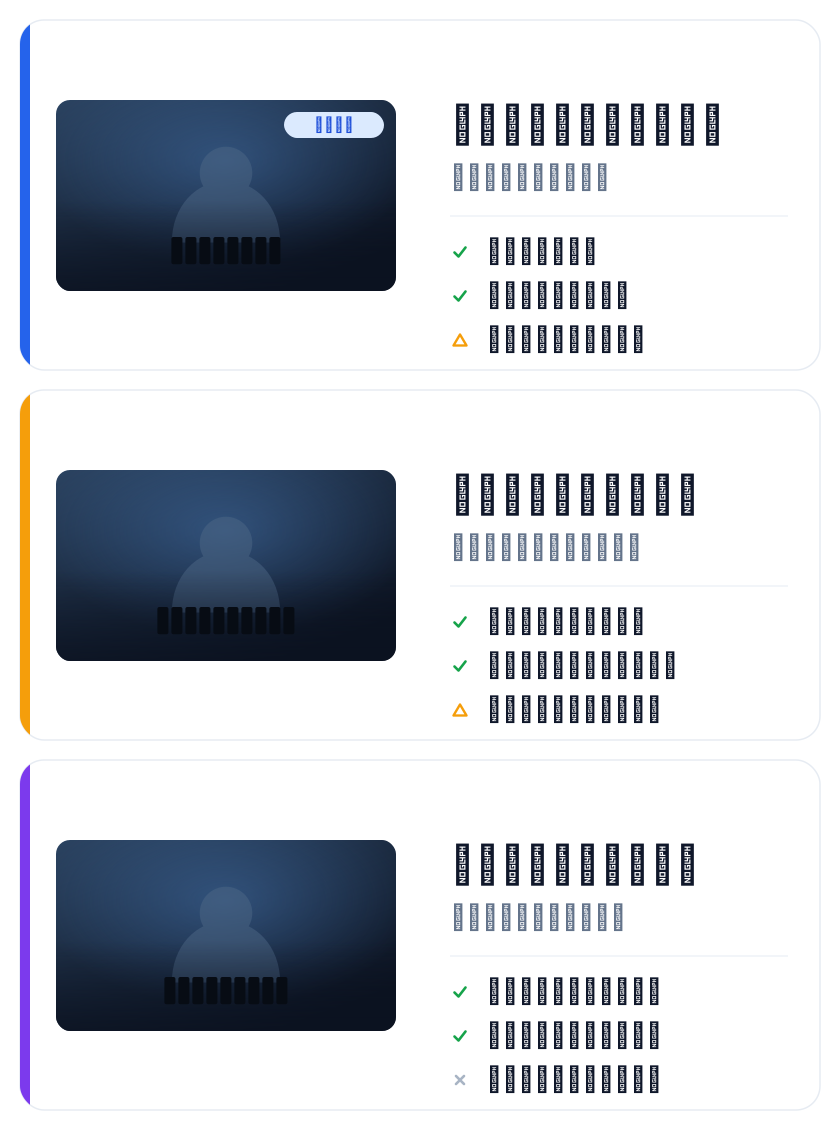
Pass one: just be a viewer. Native-language subtitles only; finish the episode without pausing or looking words up. The goal is letting the content stand up in your head first — you can't process language while lost in the plot. Note roughly where the new words were; don't stop.
Pass two: bilingual, cue by cue. Switch to bilingual subtitles; pause only where you marked. This pass builds correspondences: whether "你就等着瞧吧" maps to You'll see or Just wait — the kind of mapping no dictionary gives you.
Pass three: subtitles off. Return to the marked sections, all subtitles off, and see what you can catch by ear. If it fails, flip them back on once to compare, then off again. Only this pass trains listening — the first two trained "read and find."
Three passes sounds slow but beats "ten episodes with bilingual on": the latter only ever practiced native reading.
How to arrange the two lines: the line you're learning goes on top
Readers scan top-down; the top line gets read first — order sets priority.
| Your situation | Suggested order | Why |
|---|---|---|
| Learning the language through foreign content | Target on top, native below | Meet the line you're learning first |
| Learning a foreign language from Chinese content | Chinese on top, foreign below | The source is the anchor |
| Just want to follow comfortably | Native on top | Don't fight yourself |
More important than "which is more correct" is keeping one order for the whole episode. Switch mid-episode and every cue costs a re-orientation — attention all spent on layout.
For study, line limits should be stricter than for distribution
In distributed video, subtitles are "read once and gone"; in study, they're "read against each other" — both lines must scan at a glance or the correspondence slips.
| Metric | Recommended | Why, for study |
|---|---|---|
| Line length | Chinese ≤ 18 chars / Latin ≤ 42 | Past this you must break lines, breaking the correspondence |
| Lines | Max two | Past three, you can't find "which line pairs with which" |
| Reading speed | Chinese ≤ 9 chars/second | This is a comparison speed, not a reading speed — leave margin for looking back |
| Display time | 1–7 seconds | You can pause, so the floor needn't relax — but the ceiling still shouldn't drag |
The only thing study may relax is display time (you can pause and rewind); character count can't — over the line limit means breaking lines, and breaking lines means misaligned pairs.
Making bilingual subtitles from content you're licensed to watch
The precondition, stated plainly: use content you already have the right to watch (your own subscriptions, open courseware, podcasts, your own footage); make subtitles for personal study only. That's reasonable use within personal learning — not for distribution or uploading to public platforms.
The pipeline isn't complicated:
- Get the audio track. Use a separate audio file directly; from video-only, extract the audio first.
- Transcribe to a source SRT. The goal is an accurate timeline; rough text is fine.
- Translate to bilingual. Two routes, below.
- Spot-check one episode. Sample 10 cues; focus on break points.
Route A: generate the bilingual SRT directly — hand the source SRT to the bilingual SRT generator; the tool parses the timeline, translates the text, assembles original-plus-translation top and bottom. Best when you already have the source SRT.
Route B: run the whole pipeline from the video — upload → automatic speech recognition → translate → bilingual subtitles burned into the picture → download the final cut. Best when you want to watch directly in a player without mounting subtitle files.
If what you want is a subtitle file (mounted in a player, or fed to other tools), choose A; if you want a watchable cut, choose B.
FAQ
Why does watching with bilingual subtitles feel like no progress?
Because your fixation probably never left the native line. Simple test: rewatch the same segment with subtitles off — if you can't follow at all, your two passes trained reading, not listening; use pass three to fix it.
Can pass one go straight to bilingual and skip the native-only step?
Not recommended. Bilingual from the start makes you process plot and correspondence simultaneously — neither gets depth. The native-only pass looks like wasted time; it's actually paving the next two.
Chinese and English differ a lot in length — what if one line can't hold it?
Compress the translation first, then consider breaking. 18 Chinese characters often exceeds 42 Latin characters when translated literally — that's a translation problem, not a layout one. Line breaking is the last resort, at natural semantic pauses (after commas, between clauses), never mid-phrase.
Can I mount the subtitle file in a phone player?
Depends on the player. Most local players support external SRT, but the filename must match the video file (film.mp4 with film.srt) in the same folder. Phone support for ASS generally trails SRT — if styles don't render, fall back to SRT first.
I need bilingual for learning but only want to watch once — then what?
Then don't expect learning from that one viewing. Bilingual subtitles' value is comparison; comparison needs pauses. To save time, narrow the scope to a few segments of one episode rather than compressing three passes into one.