Submitting a Short to Festivals: English Subtitles
That line in the entry terms — English subtitles are required — many people read it carefully for the first time after their submission bounces.
During selection season one curator screens dozens, even a hundred-plus shorts back to back. They will not learn Chinese to understand your film — subtitles are the only way in. No English subtitles, and the film is closed within 30 seconds, regardless of how good it is.
That's also why English subtitles can't be "patched later when there's time": they're a precondition of submission, in the same class of technical gates as runtime, format and first-frame timecode.
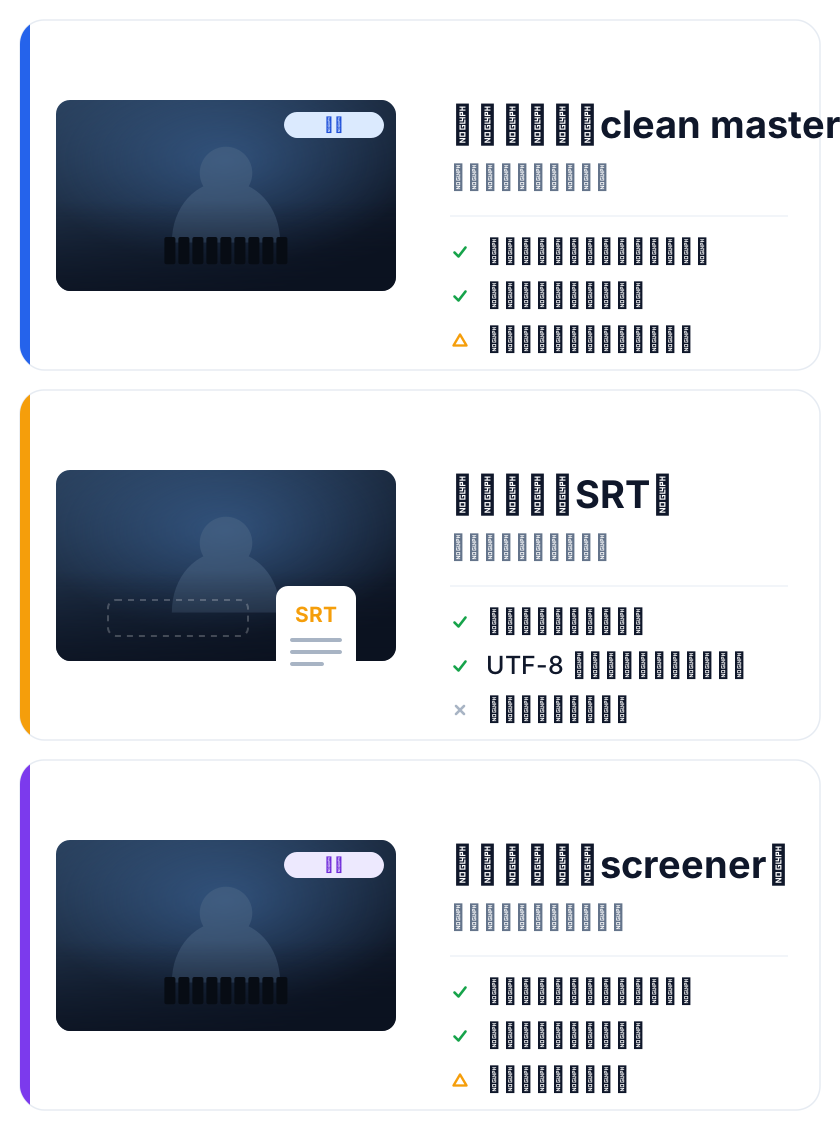
What exactly gets delivered: three items, three purposes
The first is the clean master — what you deliver after acceptance. The requirement is hard: not one piece of text on the picture — no hard subtitles, no title card, no watermark, no sponsor logo. Title and credits may exist but must come after the end (or ship as a separate file, not on the feature). Many creators habitually open with a big title; at this step that version has to be re-cut.
The second is the subtitle file. The standard delivery format is SRT; some festivals accept ASS, but as an upload deliverable SRT is safest — virtually every projection system and subtitle app reads it. ASS's advantage is style, and projection usually controls its own styling; yours won't be honored anyway.
The third is the screener (optional) — subtitles burned into the picture, made specifically for selection viewing. Why produce it separately: a curator may drop your film into a player without external-subtitle support, or preview online, and the only way to guarantee "they will see your subtitles" is making them part of the picture. But don't treat it as the final delivery — after acceptance you deliver the clean master plus the subtitle file, and hard subs on the master ruin that asset.
Frame rate: the trap that drifts the whole film's subtitles
First, a counterintuitive fact: SRT timecodes record hours-minutes-seconds and are frame-rate independent. So frame rate itself doesn't drift subtitles — what drifts them is that the master you timed against and the version finally projected have different content durations.
The classic case is the PAL-speedup version: the same film at 24 fps vs 25 fps differs 4% in runtime. Time your subtitles on the 25 fps version and pair them with the 24 fps master, and a 3-minute film ends 7.2 seconds off — viewers watch subtitles running ahead of the dialogue.
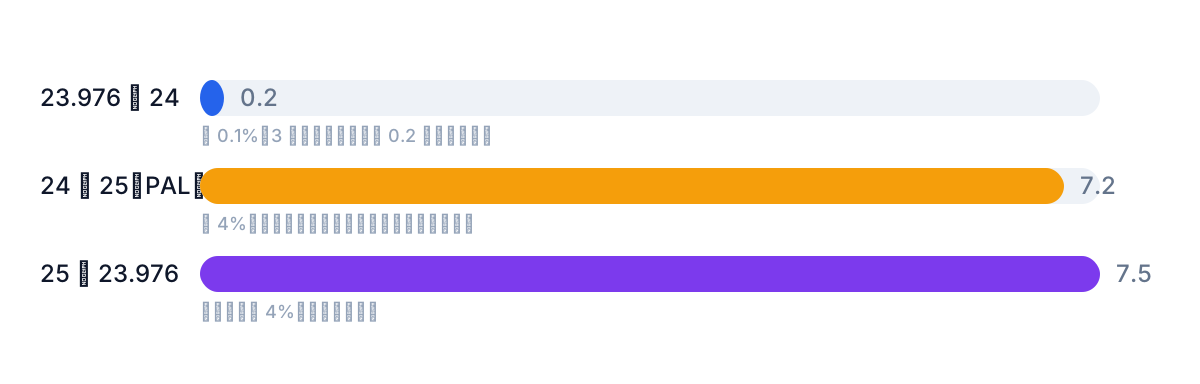
Ask three things before delivery and you save a rework round: which frame rate does their master require (24 / 25 / 23.976)? Which frame rate is your finished cut, and did both export from the same edit timeline? Does the subtitle file start at 00:00:00, or align with the master's first frame (some require 01:00:00:00)?
If you only have a 25 fps version and they want 24 fps, the right move isn't "shift the subtitles 7 seconds" — it's remapping the whole timeline proportionally. The offset is progressive and grows toward the end; a single shift can't fix it.
A subtitle spec that's enough
Festivals rarely hand you a hundred-page spec, but the most-cited industry reference is the streaming standard (Netflix's TTSG); following its numbers keeps you safe:
| Item | Recommended |
|---|---|
| Line length | Latin ≤ 42 characters (incl. spaces) |
| Lines | Max 2, no three-line stacking |
| Reading speed | ≤ 20 chars/second (children's content ≤ 17) |
| Min per cue | 5/6 second (~0.83 s) — below this viewers can't react |
| Max per cue | 7 seconds — longer reads as "stuck" |
A few easily missed ones: inaudible sounds get written ([door slams], [phone buzzing]) — they're plot, not decoration; non-English dialogue gets its language marked ((in Spanish)), or English viewers assume it's their hearing; lyrics go inside notes (♪ ... ♪) and only appear when the lyrics matter — full-song subtitling buries the picture; overlapping speakers use dashes (—But I told you) so the rhythm reads. One more common mistake: no character-name labels. The screen should carry dialogue, not ZHANG WEI: — viewers recognize voices by sound and picture.
The production pipeline
- Transcribe the source. Get the timeline right first; rough text is fine — a wrong timeline means redoing every later pass.
- Translate to English. The output here is "readable English," not "matching English."
- Native-speaker review. Non-negotiable. Non-native sentences are often grammatically correct but not how humans talk — and this is the reviewer's first impression of "is this production professional."
- Time to spec. Merge too-short cues, split too-long or overspeed ones, break overlong lines.
- QC pass. The whole film, once; checklist below.
- Export a UTF-8 SRT, filename matching the master.
Transcription and translation take longer than timing, but timing has the highest rework cost — so step 1 is worth slowing down.
QC checklist: the most common rejection reasons
Run through item by item before submitting:
- [ ] Subtitle file total duration matches the master (even one second off means the versions don't match)
- [ ] Start timecode per their requirement (
00:00:00or first-frame aligned) - [ ] Frame-rate version shares provenance with the master — not borrowed from another cut
- [ ] No leftover Chinese characters or untranslated passages
- [ ] Lines within 42 characters, never more than two
- [ ] Reading speed within bounds (especially fast dialogue)
- [ ] File encoding is UTF-8 (not GBK — Chinese software defaults cause this constantly)
- [ ] No stray style tags or font declarations
- [ ] Filename matches the video file (
film.srtwithfilm.mov)
DIY or outsource
Professional film-translation pricing spans a wide range: Chinese-market English subtitles 50–350 RMB/minute; overseas vendors (e.g. Vanan) around $11.20/minute. For a 15-minute short, outsourcing lands somewhere between a few hundred and a few thousand RMB, depending on whether native review is included.
DIY saves money and costs time; a sensible split: transcribe and draft yourself — only you know the work, and transcribing dialogue beats explaining the plot to a stranger; run translation and timing through tools — subtitle timing, line length and reading speed are mechanical rules tools can check in one pass; pay a native speaker for review — the single most worthwhile spend in the pipeline, and the only step you can't judge yourself.
Starting from the finished cut, take the online parsing route: upload your film → speech recognized automatically → translated to English → export the SRT (no burn-in), then time it to the spec above. When you need a subtitled preview for curators, burn a separate screener.
FAQ
Must subtitles be burned in?
No — and the formal delivery shouldn't be. Burning is only for the selection screener. After acceptance you deliver a clean master plus a separate subtitle file; hard subs stall technical review outright.
SRT or ASS for subtitles?
Deliver SRT: best compatibility, every projection system reads it. ASS's value is per-line style control — if you also need a Chinese-English bilingual version, use ASS for the internal version, but still export SRT as the final subtitle file.
Can't I just shift the timeline a few seconds?
No — the premise is wrong. Frame-rate mismatch causes proportional offset, not fixed offset: 7 seconds off at 3 minutes, 14 at 6. Either remap the whole timeline or redo it from a version sharing the master's provenance.
The film is bilingual — one subtitle file or two?
Follow their requirements. Most festivals want only English subtitles — deliver the English track alone; if bilingual dialogue is an artistic intent, write both languages in one cue (English on top) and note it in the delivery instructions. Don't deliver two files and make them guess which is primary.
For the screener burn, does subtitle position matter?
Yes. Don't pin to the bottom edge — many online preview players put control bars there. Follow streaming practice: subtitles sit low but with a safety distance from the bottom edge, and vertical content additionally avoids the persistent UI zones.