
What Reading Speed Works for Subtitles? Three Metrics
When viewers say "I can't finish reading the subtitle," the first guess is usually "too many words." But an unreadable cue can come from any of three overruns: the line is too long, it displays too fast, or it stays too briefly. Health-check cue by cue with three metrics — more precise than fixing by feel.
Metric one: line length
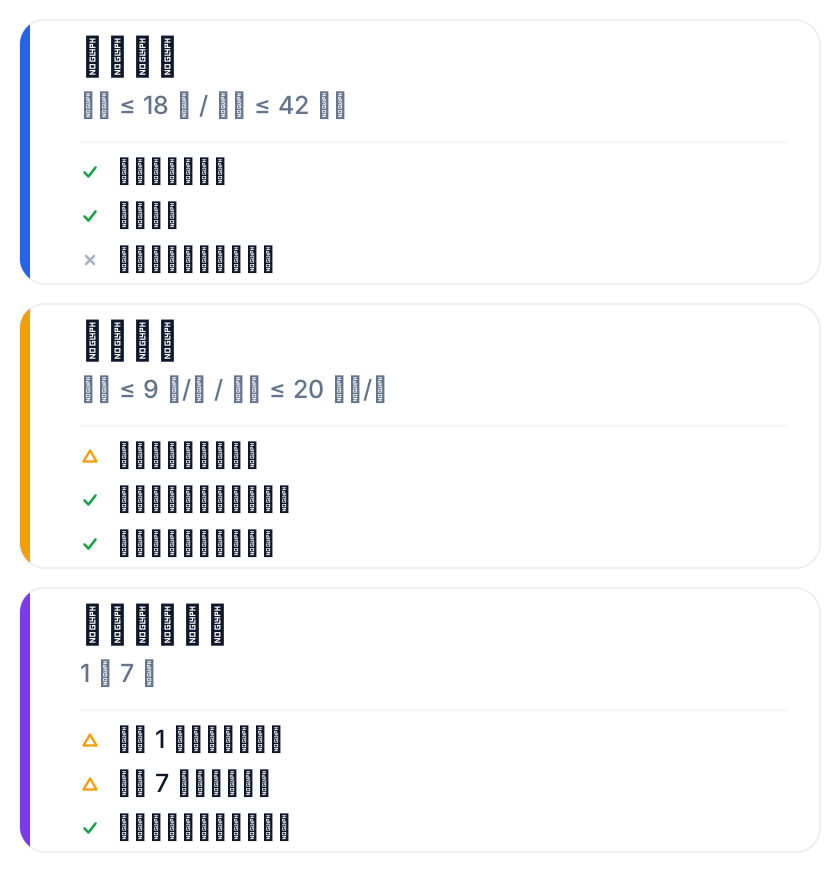
How many characters fit on one line decides whether a single glance catches the text. This site's checker uses conservative values drawn from YouTube and Netflix guidelines: max 18 characters per line for Chinese; max 42 per line for Latin scripts, at most 2 lines.
Overlong lines get squeezed into extra lines or shrunk smaller — readability drops immediately.
Why 18 and not more? Subtitles are auxiliary; the viewer's eyes still owe attention to the picture. The longer the line, the likelier a scan misses a key on-screen action — hence the conservative limit.
我们今天要讲三个问题:第一是为什么、第二是怎么办、第三是要注意什么
# 28 characters on one Chinese line — over the 18-character cap
Metric two: reading speed
Reading speed = characters ÷ display duration. The thresholds: under 9 characters/second for Chinese, 20 for Latin.
An 18-character Chinese cue needs at least 2 seconds on screen to not feel rushed. Below that speed, the text re-wraps before the viewer's eyes catch up.
Note reading speed is "characters ÷ duration" — a different axis from line length. A cue can pass on line length and still blow the speed limit if it displays too briefly.
Metric three: per-cue display time
Even if it's readable, a cue that vanishes too fast creates strain. This site's threshold is 1–7 seconds per cue: under 1 second, almost nobody finishes; over 7, the picture has moved on while the subtitle still shows the old line.
1–7 seconds is elastic — pick within it based on sentence length; don't force the middle. Display time also couples with the first two metrics: a speed overrun usually means the duration was too short (or too long) relative to the count.
One practical heuristic: dense, short-cue content (fast-paced voiceover) hits the reading-speed ceiling sooner; sparse, long-cue content (interviews) hits the line-length ceiling sooner. Know which type yours is and you know which metric to watch first — saves time.
How the three metrics interact
They aren't independent. Every cue lives under "how long, how fast, how long again" simultaneously: an overlong line forces wrapping or shrinking, raising speed pressure; a speed overrun means duration was short relative to the count; a duration violation means too fast or too slow.
So check all three together, not one in isolation. The subtitle checker sweeps all three violation classes in one pass.
If all three flag at once, fix line length first — it relieves the other two in a chain; tweaking duration alone tends to solve one cue and break the next.
# a 20-character Chinese cue displayed for only 1.5 s
00:00:01,000 --> 00:00:02,500
我们今天要讲三个问题以及对应的解决办法
# speed = 20 / 1.5 ≈ 13.3 chars/s — over the 9 chars/s cap
What to actually change when over
Work by priority. Line too long: re-break or split — one sentence into two cues, or fit within 2 lines. Speed over: extend the end time, but never past 7 seconds. Truly won't fit: go back to the SRT translator stage and tighten the translation.
After changing, re-check the neighbors: stretching one cue can squeeze the next cue's window and trigger a fresh violation. Re-run the full check after editing rather than eyeballing just the changed cue. For the fuller subtitle spec, see bilingual subtitle format.
FAQ
Which metric takes priority?
No single priority — the three interlock. Typically: keep line length within limits first, then verify speed passes, then confirm display time sits in the 1–7 second band. Any overrun should be fixed; even a single-metric overrun deserves fixing, just with weaker chain effects.
Why different thresholds for Chinese and Latin scripts?
Chinese characters are square and information-dense, measured in characters per second; Latin is measured per character because word lengths vary widely. The two have different physiological reading rhythms, hence separate limits.
Is every checker-flagged overrun a real problem?
The thresholds take the conservative side of mainstream platform specs, to leave safety margin. Occasional artistic choices (deliberate fast cuts) can be exceptions, but for batch overseas content, follow the standard — it lowers viewer drop-off.