Japanese Subtitles for Chinese Videos: 4 Key Traps
Chinese and Japanese both use kanji, so many assume Chinese-to-Japanese is easy. Actually making Japanese subtitles reveals the problems live exactly where the two scripts look most alike.

One: Japanese runs longer, and subtitles burst
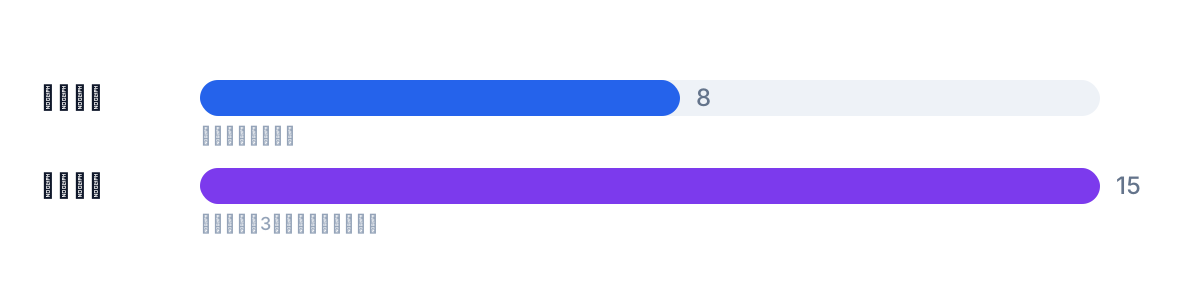
Chinese is highly compressed; the same sentence in Japanese often doubles or more in characters:
| Chinese | Japanese subtitle | Characters |
|---|---|---|
| 谢谢 | ありがとうございます | 2 → 9 |
| 明天下午三点开会 | 明日の午後3時に会議があります | 8 → 15 |
| 请多关照 | よろしくお願いいたします | 4 → 12 |
Japanese needs particles and endings to mark grammar and kana to connect the pieces between kanji — the character count naturally climbs. Meanwhile Japanese subtitle convention is roughly 15 full-width characters per line, at most two lines. A 10-character Chinese line can easily fill the frame width in Japanese.
The practical advice is one line: control sentence length while writing the Chinese script, and proactively split long sentences in two.
Two: honorific levels — stay consistent with the scene
In Japanese, the same meaning changes with the addressee. The most common subtitle flaw isn't a wrong choice but inconsistency across the video — polite in the first half, suddenly casual in the second.
Client- or audience-facing product and corporate videos: higher politeness, uniform throughout; general-audience voiceover and explainers: mid-politeness everyday speech, natural not stiff; vlogs and drama follow the character's mood and can be casual, but the same character stays consistent front to back.
Speaking-to-a-client scenes (say, an export product intro) follow client speech: 「わかりました」 becomes 「かしこまりました」 in client settings. Get the register wrong and viewers notice immediately.
Three: kanji that look the same but mean differently
The stealthiest Chinese-to-Japanese trap: many kanji compounds share the Chinese spelling but carry different meanings.
| Japanese word | Meaning in Japanese | Meaning in Chinese |
|---|---|---|
| 手紙 | letter | toilet paper |
| 娘 | daughter | mother |
| 勉強 | study | reluctantly |
| 検討 | study, discuss | self-criticism |
| 丈夫 | sturdy | husband |
Mis-translate one of these and native viewers immediately lose the context. Machine translation rarely makes this mistake — it's human "quick tweaks" that usually break it. Japanese punctuation differs too: breaks use 「、」「。」, quotes use 「」.
Four: line length and breaking habits
Keep one line around 15 full-width characters, at most two lines. Break at 「、」, never before particles (は, が, を…), never split a word across lines. Don't shrink the font to fit a line — unreadable on phones. Leave enough display time too: Japanese has more characters and takes longer to read; time the cue by the Japanese character count.
Vertical video needs extra care: Japanese subtitles take more width than Chinese, and bilingual on-screen eats a big chunk of the lower frame — shrink both languages' font sizes and leave safe margins for platform UI overlays.
Tools cut the repetitive work
On SmileSub, upload the video and pick Japanese as the target — recognition, translation and bilingual burn-in run together, download the final cut; 20 languages translate among each other.
If the subtitle file is already in hand, the free SRT translator makes a Japanese version; for a Chinese-Japanese side-by-side file, use the bilingual SRT generator. Both are no-login, capped at 1MB and 500 cues per file, 3 uses per tool per IP per day.
FAQ
Is machine translation enough for Chinese-to-Japanese subtitles?
Everyday voiceover and corporate intros, mostly yes. Risk concentrates in technical terms and dialogue needing honorific judgment — have a native speaker pass over those two.
How many characters per line for Japanese subtitles?
Common convention: around 15 full-width characters per line, at most two lines; vertical video is narrower, so be more conservative.
Japanese has so much kanji — can a Chinese script be lightly edited and used?
No. Same-form-different-meaning is common, and Japanese needs kana to connect grammar; transplanting Chinese word order usually doesn't parse.
For Chinese-Japanese bilingual subtitles, is keeping the Chinese line necessary?
Depends on placement. Japan-only, the Chinese line eats the layout meant for Japanese; shipping to Chinese platforms too, or needing internal verification, bilingual is more convenient.