
Video Subtitles Aren't Just for Deaf Viewers
Many treat subtitles as "an accessory for deaf viewers" and skip them outside accessibility contexts. But in real viewing environments, large numbers of people watch muted, in noisy places, or across languages — there subtitles solve "can I watch this at all," not just "what about people who can't hear." Break the value apart and at least four practical reasons emerge.
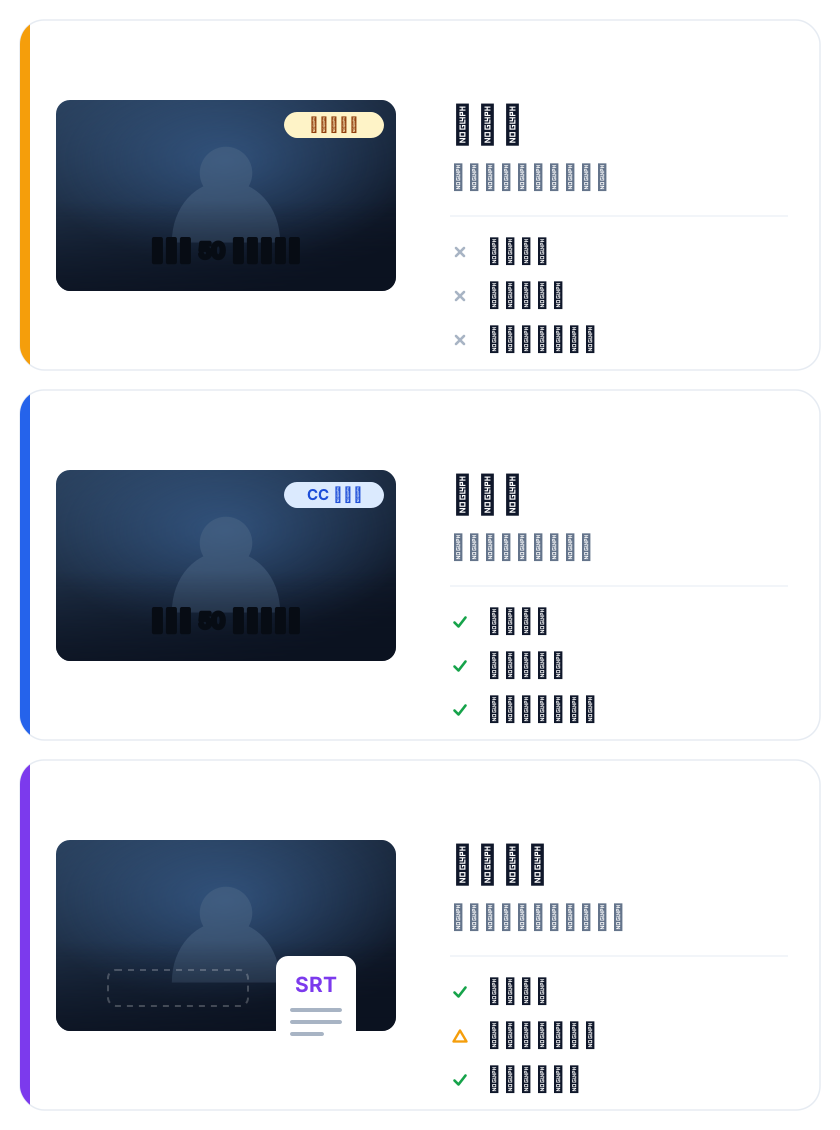
Value one: watchable with the sound off
Subway, office, late-night in bed — plenty of videos are scrolled past muted. Without subtitles, completion rates in these scenes drop noticeably, because the viewer neither hears the audio nor will unmute.
Social feeds autoplay muted by default; subtitles let the key first 3 seconds land without sound — like a title card for the video while muted. The higher the muted share, the closer subtitles are to the video's only information channel, not a garnish. Burned-in guarantees everyone sees them; soft tracks depend on platform support.
Value two: non-native viewers patch their listening with text
Overseas viewers are often in a "can read English, can't quite hear it" state. Subtitles turn speech into visible text and close the listening gap.
Generate target-language subtitles with the SRT translator covering English, Spanish, Portuguese, German, Japanese, Korean and more. Non-native readers read slower than natives, so keep line length restrained: max 18 characters per line for Chinese, 42 for Latin. Bilingual subtitles are especially useful for new markets — produce them in one pass with the bilingual SRT generator.
Value three: search and recommendation can "read" your video
A good part of how platforms understand video content comes from subtitle text. Closed captions (CC) upload as structured text the platform can index and match to recommendations.
Upload SRT/VTT so the platform can harvest keywords — see subtitles and YouTube search. Burned subtitles are picture pixels the platform can't read — low SEO value. Web-video subtitles use VTT, converted with the SRT to VTT tool.
Value four: subtitles are a reusable content asset
Subtitle text is already a transcript — one production pass, many downstream uses, no extra cost.
As the text version of the description: SEO and readability, indexable by search engines outside the platform; split into quotes and key points for image-text social, without re-listening; as internal archive, ready to consult when copy changes or languages get added, skipping re-transcription; support and sales can quote "the line from the video" straight from the transcript instead of hunting timecodes. The text extraction tool pulls all the text out in one go.
A subtitle file's marginal cost is low; the downstream uses it supports are many — doing subtitles properly up front pays off long-term.
Closed captions and burned-in: why you usually want both
It isn't either-or — they serve different channels. Platforms that take CC (YouTube and the like) keep closed captions: viewer freedom plus machine-readable text; vertical social and ad placements burn subtitles so they show even without toggling. One SRT source, two forms, no extra work.
For the detailed trade-offs, see burned-in vs soft subtitles.
FAQ
Do closed captions and burned subtitles each need making?
Make both. CC-capable platforms trade closed captions for SEO and viewing freedom; social and ads burn to guarantee reach. Both come from the same SRT — only the export form differs.
Do burned subtitles hurt the visual?
Not if controlled. Avoid the safe area, add outline or a backing bar for contrast, size by the longer line. A spec check confirms line length and display time are in bounds.
Is English-only CC enough for going overseas?
Fine when the target market is English-speaking. To cover Spanish, Portuguese, German and beyond, one or two extra subtitle tracks cost very little — SmileSub translates among 20 languages.