
What Does Subtitle Translation Cost?
Asking "how much does subtitle translation cost" is like asking "how much does a renovation cost" — without volume and delivery requirements, every answer is wrong. But cost does decompose: plug your numbers into the variables below and a sane order of magnitude falls out.
First, the cost structure: only three variables
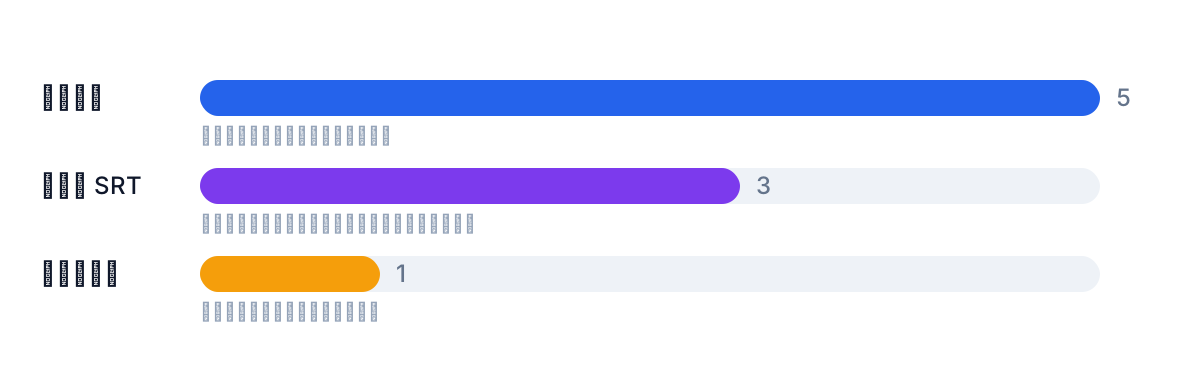
Three variables: minutes — count finished-video duration, not file size; language count — how many target languages, and note this multiplies: 5 languages is 5 jobs with almost no volume discount; delivery form — subtitle file only, burned into a final cut, or voiced. Each extra layer pushes both cost and timeline up.
Total cost ≈ (one-off: transcription + timing) + (per-volume: translation × language count) + (delivery: encode / voiceover)
Note the first term has no language count — transcription and timing happen once. That term is where the savings live.
The most overlooked fact: the big cost usually isn't "translation"
In a human pipeline, one subtitle file passes through transcription (speech to text), timing (splitting timecodes — in/out points and line breaks per cue), translation, proofing, formatting.
Transcription and timing can't be skipped and don't speed up by understanding context; on many projects they take longer than the translation itself. So the most practical conclusion: whether you already have an SRT decides the order of magnitude — with an SRT, the two most time-consuming stages are done; without one, every route starts at transcription.
Human translation: priced per minute
The unit is usually finished minutes × language pair, and the differences between quotes hide in details: does the quote include transcription and timing? "Here's an SRT, translate it" and "here's a video, do everything" are not the same job. Is there a minimum order? 2 minutes may cost the same as 20. Domain premiums count too — legal, medical and technical content needs specialist translators.
Hidden costs: glossary preparation, delivery lead time, rework communication, and the gap between "review an existing translation" and "translate from scratch" — the latter is usually clearly more expensive.
Machine translation: priced per character
MT APIs charge by character (commonly quoted per million characters); the unit price is so low it nearly vanishes from the total. But it only solves the "translation" stage — the rest is still your job: SRT is structured, so dumping it into a translation API translates the index numbers and timecodes too; you must parse the text first and reassemble onto the original timeline after. Translating cue by cue, the model sees no surrounding context, so person, reference and terminology drift mid-file. And machine output always needs a proofing pass — especially for professional content.
Its cost curve: the bigger the volume, the cheaper the unit price — but your time cost barely moves.
Integrated online tools: what you save is process cost
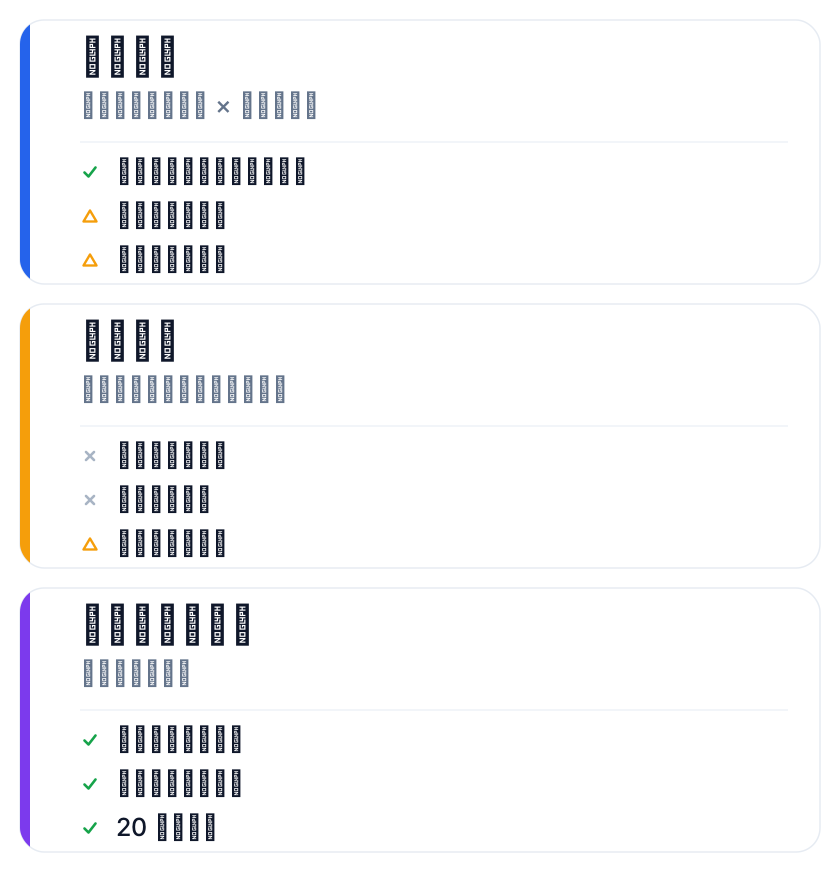
The third route packs transcription, translation and assembly into one action. What changes isn't the translation unit price — it's the process cost, because the two expensive stages, transcription and timing, are done automatically by speech recognition.
Take SmileSub as an example: upload video → speech recognized automatically → translated → bilingual subtitles burned into the picture → download the final cut. Burning happens in the browser and the video itself never uploads. 20 languages including Chinese, English, Japanese and Korean translate among each other.
If you already have an SRT, the free tools skip the video stage entirely: the SRT translator outputs a translated version; the bilingual SRT generator outputs an original-plus-translation stacked version. Both are no-login, limited to 1MB and 500 cues per file, 3 uses per tool per IP per day.
For an estimate, walk this order: total minutes; how many target languages (remember, it multiplies); delivery form — file, final cut, or voiceover; budget proofing time; run one 3-minute pilot, derive a unit price, then scale.
FAQ
Why can quotes differ several-fold across channels?
Because they're not selling the same thing. Align the deliverable list first: subtitle file or final cut, transcription and timing included or not, how many revision rounds.
Is subtitle translation priced per minute or per word?
Both exist, but per minute is more common — transcription and timing workload tracks duration, not word count. Per-word pricing usually means "you give me text, I only translate" — first confirm who does transcription and timing.
Is adding one more language just a little more money?
No. Translation bills per language pair, so each new language is roughly one more job, usually without meaningful discount. But transcription and timing are one-off — adding a language to an already-timed project costs less than starting from zero.